How to calculate added sugars for a nutrition label
Added sugars is the only sugar number on the label with a legal definition, and the definition is narrower than most people assume. Here is exactly what counts, how the two sugar numbers print, and a worked example you can check against your own recipe.
1. What the regulation actually says
There is no room for interpretation here, so it is worth reading the sentence itself. From 21 CFR 101.9(c)(6)(iii):
Read it as three limbs, because that is how you apply it to a recipe:
- Sugar added during processing. Sucrose, dextrose, glucose, fructose, high-fructose corn syrup, malt extract — anything you poured in.
- Foods packaged as sweeteners. A bag of granulated sugar, a jar of honey, a bottle of maple syrup. The regulation names "syrups and honey" specifically, so the fact that honey is unrefined and unprocessed does not help you.
- Sugars from concentrated fruit or vegetable juice, in excess of what 100% juice of the same type would contribute. This "in excess" test is the one people miss. See case 4 below.
The same paragraph then carves out some cases that would otherwise look like the third limb. Juice concentrates are not added sugars when they are used to make a 100% juice product sold to consumers, to meet the total-juice percentage declaration under § 101.30, for Brix standardization under § 102.33(g)(2), or as the fruit component of jellies, jams, preserves and fruit spreads.
2. Total Sugars has no Daily Value. Added Sugars does.
This asymmetry surprises people, and it changes what your panel looks like.
- Total Sugars carries no %DV column value at all. There is no Daily Value for total sugars, because no recommendation has ever been made for a total amount to eat per day. The row prints the gram amount and leaves the right-hand column blank.
- Added Sugars does carry one. The Daily Value is 50 grams per day, based on a 2,000-calorie diet. That number comes from the Dietary Guidelines for Americans, which recommend keeping added sugars below 10 percent of calories: 10% of 2,000 calories is 200 calories, and at 4 calories per gram of sugar that is 50 g.
For context on what the %DV means to a shopper, the FDA's own guidance is that 5% DV or less of added sugars per serving is a low source and 20% DV or more is a high source.
3. How the two numbers print
Added sugars is not a free-standing row. It is indented under Total Sugars and prefaced with the word "Includes". Again, the text:
| If a serving contains | You may declare |
|---|---|
| 0.49 g or less | 0 g |
| 0.5 g to 0.99 g | "Contains less than 1 gram" or "less than 1 gram" |
| 1 g or more | the nearest gram |
One exemption is worth knowing because it is genuinely useful: if a serving contains less than 1 gram of added sugars and you make no claim about sweeteners, sugars, added sugars or sugar alcohols anywhere on the label or in advertising, you are not required to declare added sugars at all. For a savory product that is often the whole story.
4. Worked example: honey almond granola
Take a recipe that contains both kinds of sugar at once, which is the normal situation for a baked good. This is a 500 g batch of honey almond granola, divided into 10 servings of 50 g each.
| Ingredient | Grams | Sugars per 100 g | Sugars in recipe | Counts as added? |
|---|---|---|---|---|
| Rolled oats | 250 | 0.99 g | 2.48 g | No — naturally occurring |
| Honey | 80 | 82.12 g | 65.70 g | Yes — all of it |
| Brown sugar | 40 | 97.02 g | 38.81 g | Yes — all of it |
| Almonds | 60 | 4.35 g | 2.61 g | No |
| Raisins | 40 | 65.18 g | 26.07 g | No — intrinsic to the fruit |
| Butter | 30 | 0.06 g | 0.02 g | No |
| Batch total | 500 | — | 135.68 g | 104.50 g added |
The two divisions that matter:
- Total Sugars: 135.68 g ÷ 10 servings = 13.57 g per serving → prints as 14 g.
- Added Sugars: 104.50 g ÷ 10 servings = 10.45 g per serving → prints as "Includes 10g Added Sugars", which is 20% of the 50 g Daily Value.
Note that the raisins carry more sugar, gram for gram, than almost anything else in the recipe — and none of it is added sugar. That is the whole point of keeping the two numbers apart.
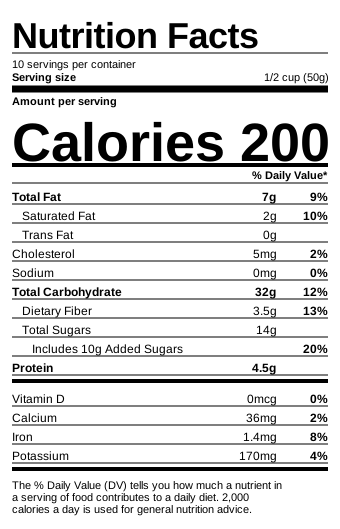
Two details on that panel are worth pausing on, because they look wrong and are not:
- Sodium prints as 0 mg. The recipe actually contains about 4.4 mg of sodium per serving. 21 CFR 101.9(c)(4) says a serving with less than 5 mg of sodium is expressed as zero. "0 mg" is the legally correct declaration, not a rounding error.
- The 20% is computed from the declared 10 g, not from 10.45 g. 21 CFR 101.9(d)(7)(ii) lets you divide either the amount you declared on the label or the actual pre-rounding amount by the Daily Value. Both are permitted; the label builder here uses the declared amount, consistently.
5. The six cases that trip people up
1. Honey, maple syrup and agave are all added sugars
There is no "natural sweetener" category in the regulation. Honey appears in the definition by name, alongside syrups. If you sweeten with it, it is an added sugar, and the %DV will be reported to the shopper as such. The same goes for coconut sugar, date syrup, rice syrup and evaporated cane juice — the label does not care how the sweetener was marketed.
2. Dried fruit is naturally occurring sugar — unless it was sweetened
Raisins, dates, dried figs and dried apricots are dried, not sweetened. Their sugars are intrinsic to the fruit, so they add to Total Sugars and contribute nothing to Added Sugars. The exception is sweetened dried fruit — sweetened dried cranberries, for example, are infused with sugar during processing, and that infused sugar is an added sugar. If an ingredient is called "sweetened", treat the added portion as added sugar.
3. A fruit yogurt splits three ways
The lactose from the milk is naturally occurring. The sugar that came in with the fruit is naturally occurring. Only the sugar added to sweeten the yogurt or the fruit preparation is an added sugar. If you bought the yogurt already sweetened, you cannot see the split from the nutrition panel alone — you need the ingredient list.
4. 100% juice versus juice concentrate used as a sweetener
This is where the "in excess of" language earns its keep. The sugar in a glass of 100% apple juice is not added sugar. But if you add apple juice concentrate to a recipe to sweeten it, the sugars that concentrate contributes above what the same volume of 100% apple juice would have contributed are added sugars. In practice, for a recipe builder, the safe and defensible treatment is to treat a fruit juice concentrate used as a sweetener as an added sugar in full, and to note the assumption in your records.
5. Fermentation and browning genuinely reduce added sugars — but you must document it
Bread dough is the classic case: you add sugar, the yeast eats some of it. The regulation acknowledges this and lets you declare the amount left after fermentation and non-enzymatic browning, but only if you can demonstrate it. 21 CFR 101.9(g)(10)(v) requires written records of the added sugars before and during processing, and adds a hard ceiling: "in no event shall the amount of added sugars declared exceed the amount of total sugars on the label." If you cannot produce the records, you may not declare less than what you added.
6. Any sugar claim changes the rules
Saying "no added sugar", "low sugar" or "reduced sugar" puts you into nutrient-content-claim territory, which means the claim itself has to meet a defined threshold, and it generally removes the small-business exemptions described in our guide to labeling for small producers. If you want to make a sugar claim, budget for getting it right.
6. Rounding and the 20 percent tolerance
Once you have the per-serving gram figure, the rounding is mechanical: nearest gram, with the "less than 1 gram" and "zero" carve-outs in the table above.
The %DV for added sugars is a different rule from the vitamins and minerals. It is expressed to the nearest whole percent under 21 CFR 101.9(d)(7)(ii) — the wide 2/5/10 percent bands apply only to vitamins and minerals. Our rounding rules reference has the complete table for every nutrient.
How accurate does the number have to be? 21 CFR 101.9(g)(5) makes a food misbranded if the actual nutrient content of the composite exceeds the declared value by more than 20 percent. That tolerance runs in one direction only: under-declaring is the risk. It is also not a license to declare a low number and hope — the declared figure still has to be the figure your recipe produces.
7. What you have to keep on record
If a food contains a mixture of naturally occurring and added sugars, you are required to make and keep written records of the amount of added sugars you added during processing — 21 CFR 101.9(g)(10)(iv). In practice that means: keep the recipe, keep the batch weight, and keep the per-ingredient numbers you used. 21 CFR 101.9(g)(10) accepts "analyses of databases, recipes, formulations, information from recipes or formulations, or batch records" as the evidence.
That is also why calculating from a documented database is a legitimate route rather than a shortcut. See how to calculate nutrition facts from a recipe for the arithmetic and the error sources.
Let the builder do the sugar split for you
Search your ingredients, set the amounts, and the label updates live — with an "added sugar" flag on every ingredient that needs one, which you can override per ingredient when your recipe calls for it.
Build my label — free Pro · $19 once